

Sawdust dryer technologies comparison
Drum dryer
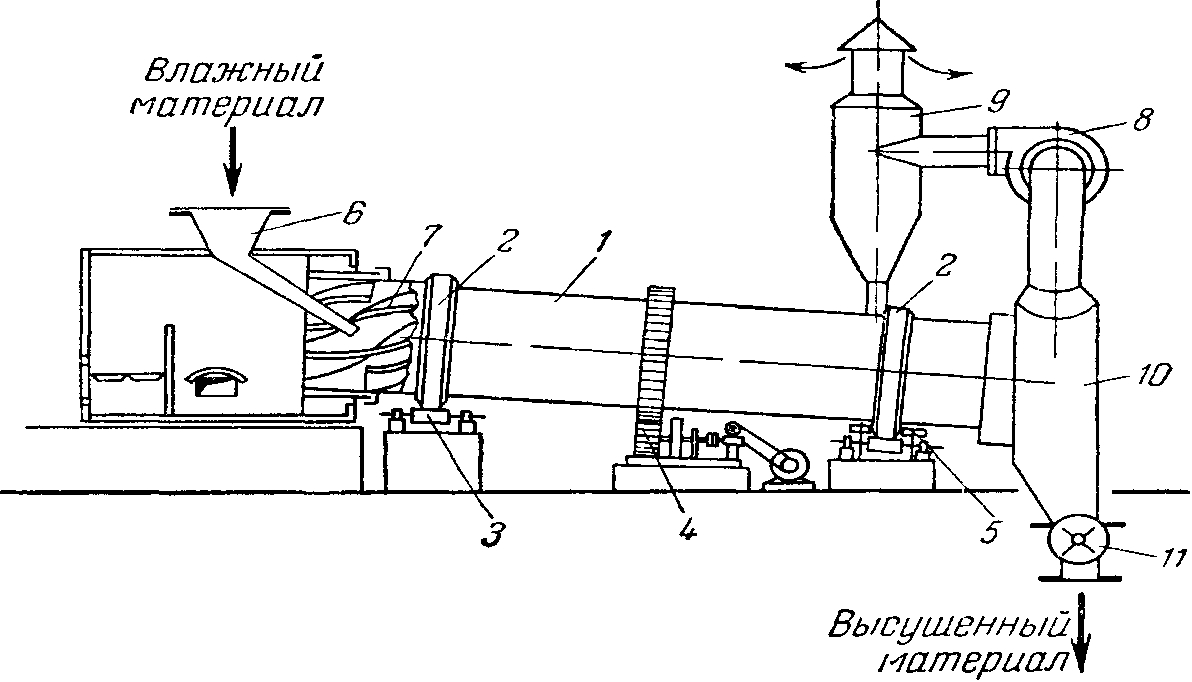 Raw material flows
into drum, drum rotates, overheated gas from heat generator is
flowing through the drum. A steam bath is formed in the drum.
Water in raw material turns into steam as it’s overheated.
Material and flue gases flow into exhaust fan and then settle
in a cyclone filter. Overheated gases and steam with raw
material pieces go out into the atmosphere.
Raw material flows
into drum, drum rotates, overheated gas from heat generator is
flowing through the drum. A steam bath is formed in the drum.
Water in raw material turns into steam as it’s overheated.
Material and flue gases flow into exhaust fan and then settle
in a cyclone filter. Overheated gases and steam with raw
material pieces go out into the atmosphere.
Let’s look at the process in detail At the moment when gases enter the drum, average gas temperature is about 600 degrees. Tiny particles are burnt up and settle as a coal residue as they interact with raw material. Coal residue (0.5-5% of product content) is processed alongside with raw material and affects final product (making its color grey). Total material volume is decreased by 5%.
Another problem that occurs when processing raw materials is thermo modification. Medium-sized sawdust pieces are being thermo-modified if they are dry enough. Lignin turns from a plastic form into crystal one. This is an irreversible process which affects product bonding. The percentage of thermo-modified material can reach 60%.
Another disadvantage of this technology is high fire hazard (the highest of all technologies). On average, drum dryers are burning one time a year, so it’s unsafe to keep drum dryers indoors.
Drum dryers usually have medium size, but they are hard to transfer because heat generator lining can be damaged
Drum bandage(rail) wears out in 2-3 years of 24/7 work. Bandage cost starting from 5,500€. Drum is placed on two bandages, making service cost very high
Oxygen needs a lot of place in drum so drum is always not fully filled. That is why you need to greatly increase drum if you want to dry more raw material.
Drum dryers consume a lot of power. Production process cannot be fully automated. One of advantages is low price, but at the same time it can be disadvantage because of low sell price. Typically, drum dryers service life is about 5 years.
Machines of this type can dry small fraction raw material: sawdust, wood chips, grain. Drying large fraction material is unprofitable.
| cost | 85 000 € |
| performance | 1 ton per hour |
| personnel | 1-2 men |
| working hours per year | 280 |
| power | 63 kWh |
| solid fuel consumption | 0.7 m3/h |
| cost price per ton | 1 year– 33€ 5 years– 23€ 10 years– 22€ |
Vortex dryer
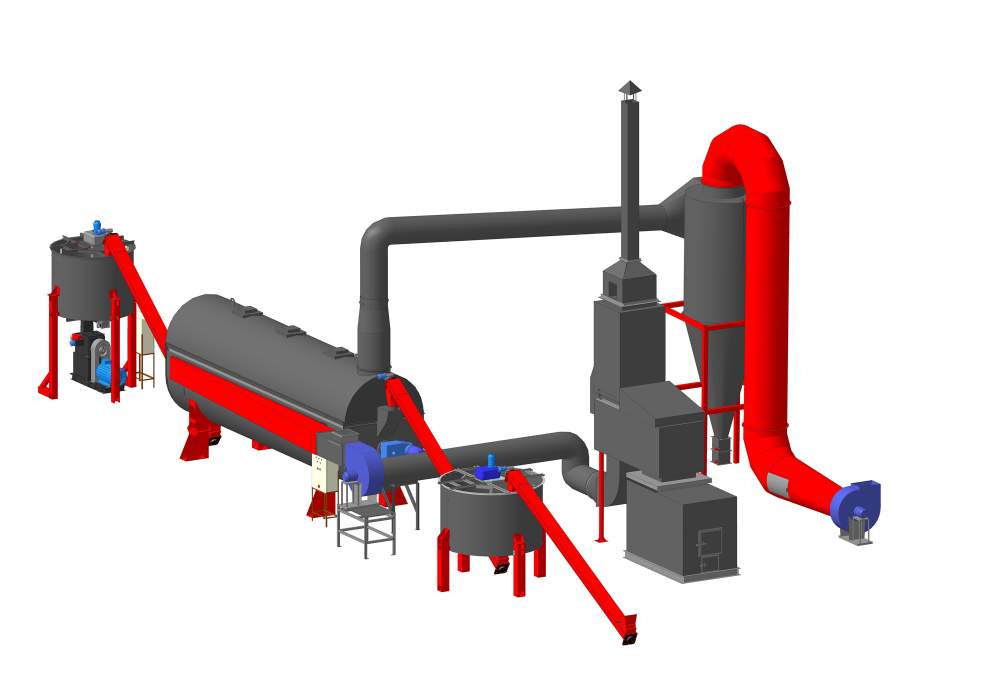
Dryers of this type are made for processing such materials as sawdust, wood chips, agriculture products. Operation principle: raw material flows from intermediate hopper into drum. Drum has rotating shaft, which shuffles raw material. Heated air flows from top, takes raw material moisture and tiny dust pieces, and then flies into the atmosphere.
Vortex dryers needs to clean the air they emit into the atmosphere. It has high price, low performance (typically twice less then declared by manufacturer), not fire-hazardous. Raw material don’t change color in production process.
Max possible performance is 1 ton per hour. Vortex dryers has medium size. They are not widespread because of high price and low performance.
| cost | 70 000 € |
| performance | 0.5 tons per hour |
| personnel | 1 man |
| working hours per year | 300 |
| power | 45 kWh |
| solid fuel consumption | 0.4 m3/h |
| cost price per ton | 1 year– 49€ 5 years– 34€ 10 years– 31€ |
Aerodynamic dryer
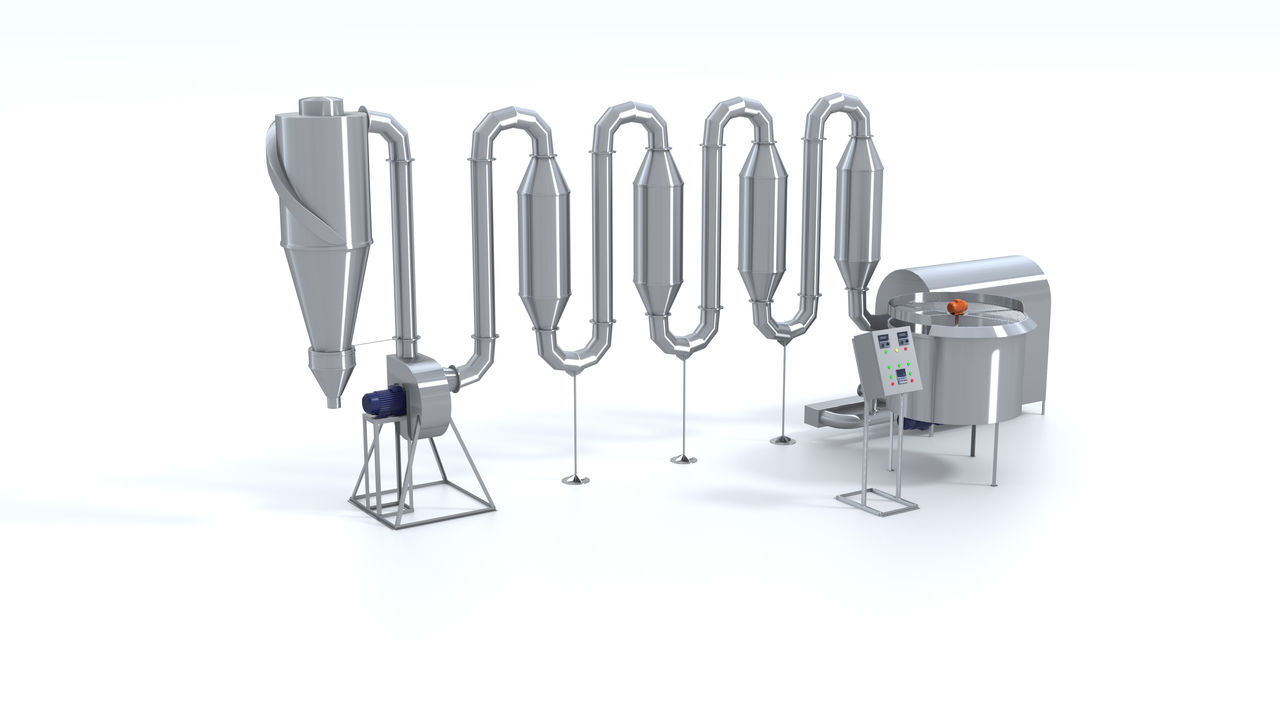 Dryers of this type
are suitable for small businesses because of their tiny
performance and efficiency as well as their low price. Machines
typically have small size and are easy to install and
transport.
Dryers of this type
are suitable for small businesses because of their tiny
performance and efficiency as well as their low price. Machines
typically have small size and are easy to install and
transport.
Production process is similar to drum dryer process: overheated gases are passing through pipes, transport and heat raw material.
Raw material is being charred. Charring percent in aerodynamic dryers is higher then in other technologies listed and is from 2 to 7 percent. Thermo modification has more impact on product in this technology type.
Use of aerodynamic dryer product in pellets production is not possible as it is not efficient because products would have poor quality.
Full automation is not possible.
On this type of equipment, it is possible to dry raw materials of extremely small fraction, and only of wood origin, only for briquetting, for bedding livestock, when burning in a heat generator, and so on.
| cost | 15 000 € |
| performance | 0.2 t/h |
| personnel | 1 man |
| working hours per year | 300 |
| power | 63 kWh |
| solid fuel consumption | 0.7 m3/h |
| cost price per ton | 1 year– 49€ 5 years– 34€ 10 years– 31€ |
Belt dryer
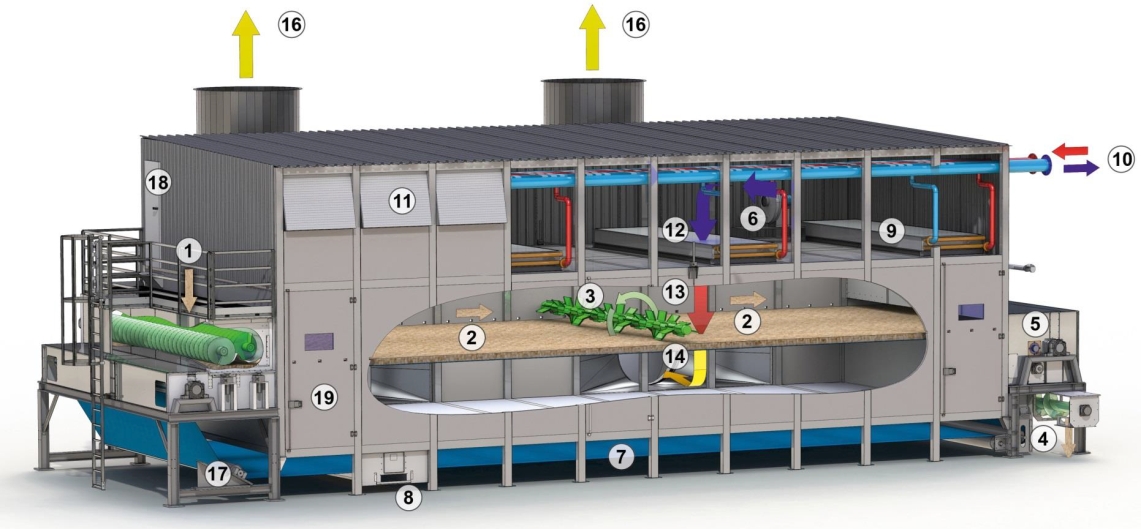 Dryer is tunnel
construction with fans. Raw material is moving on conveyor belt
which runs along the entire structure
Dryer is tunnel
construction with fans. Raw material is moving on conveyor belt
which runs along the entire structure
Heated water or air is used as a drying agent. One of heat sources options is electric infrared heater, but is consumes a lot of energy and considered inefficient.
Raw material is lying on conveyor belt as 1-15cm layer and is rotated only once. On average, raw material passes dryer in 30 minutes. Time depends on initial and final moisture.
Dryer efficiency is medium, because performance depends on raw material type. Machine of this type can have almost any performance, it’s limited with customer’s ability. Production process can be fully automated.
Need for separate boiler room is disadvantage of belt dryers because it entails additional expenses that could be equal to machine cost. Machine cost is about 250 000 € for dryer with 1.5 tons per hour performance.
Belt dryers are most inconvenient because of their size. It can affect total price
Machines of this type can dry almost any material: from wood chips to agriculture products.
| cost | 250 000 € (boiler room not included) |
| performance | 1.5 tons per hour |
| personnel | 1 man |
| working hours per year | 340 |
| power | 78 kWh |
| solid fuel consumption | 1.5 Gcal/h |
| cost price per ton | 1 year – 87€ 5 years – 74€ 10 years – 67€ |
Screw dryer
 Dryers of this type
appeared recently and gathered all the best practices from
other existing technologies.
Dryers of this type
appeared recently and gathered all the best practices from
other existing technologies.
Raw material goes into screws system and flows from row to row. Raw material is shuffled, dried and heated while interacting with screws and wet air.
As flue gases don’t interact material and material is moved by screws, there are many available material types. It’s possible to dry material which is prone to sticking together because screws will grind material and make product with almost no lumps
Material is not affected by thermo modification or charring. Drying temperature is set via operator panel with range of 60 to 150 degrees and depends on material type and wanted drying speed. There is no steam or dust emission during production process, because all steam and dust are passing through separate heat generator camera.
Steam is overheated and is not visible as emission, dust is just being burnt. Size (per product) is one of the most compact from all listed technologies. Machines are not fire hazardous.
Screw dryers are cheap at service. Screws are made of stainless steel. Service life starts from 10 years.
Dryer works in fully autonomous mode. It gives a number of advantages:
- Optimal energy and heat consumption
- Ability to gather data about production process and form statistics. This allows to make reports (in excel format, for example), which will contain, for example, how much raw materials were dried, what was their humidity, how much energy was consumed, etc
- Remote access and control
Screw dryers performance can be almost any
| cost | 85 000 € |
| performance | 1.5 tons per hour |
| personnel | 1 man |
| working hours per year | 340 |
| power | 22 kWh |
| heat consumption | 0.6 m3/h |
| cost price per ton | 1 year – 27€ 5 years – 22€ 10 years – 21€ |